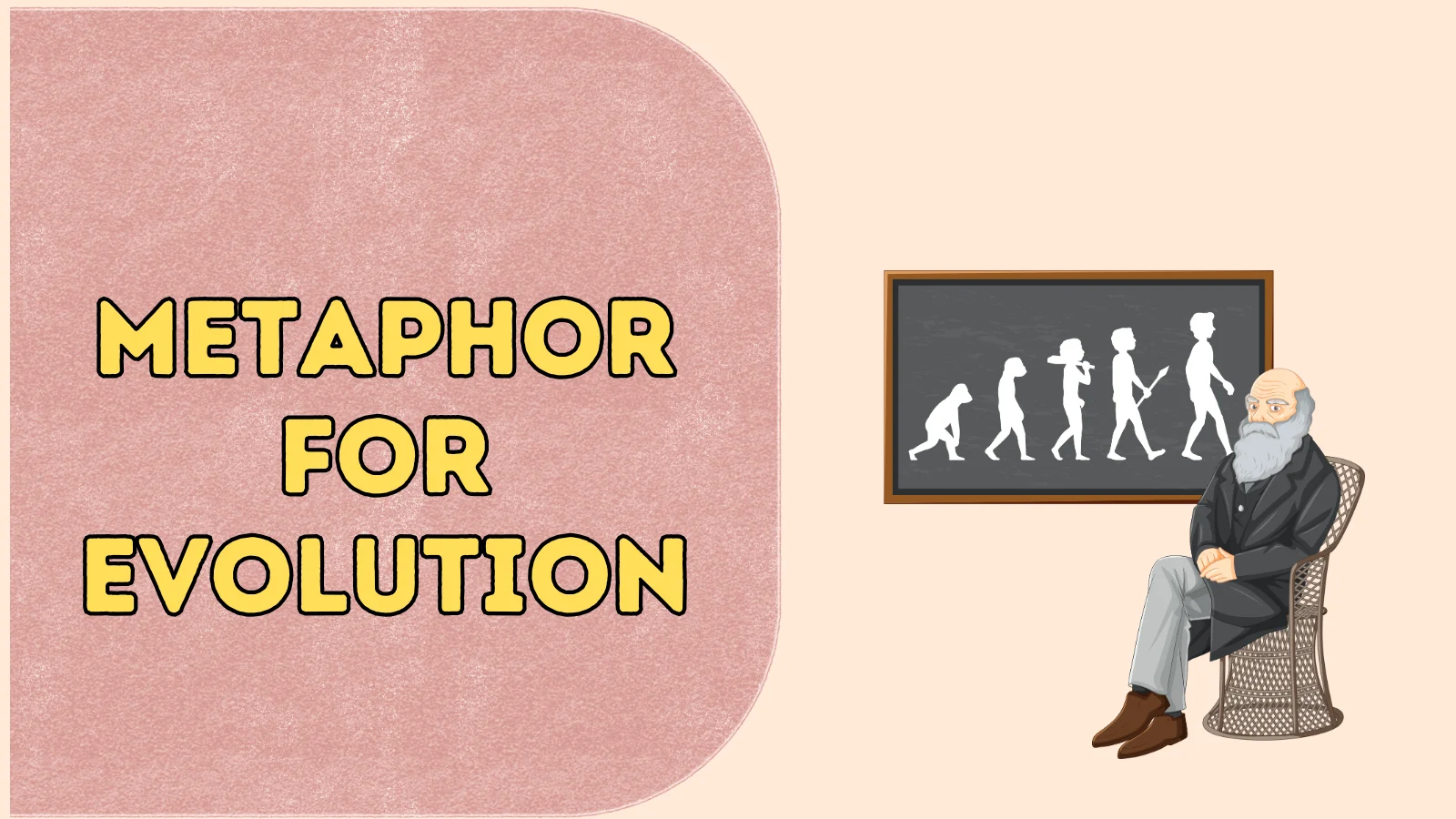
A metaphor for evolution can turn the abstract idea of change into something readers can easily picture and feel. Evolution can describe biological development, personal growth, cultural change, technological progress, or the gradual transformation of an idea.
Instead of simply saying, “The company evolved,” a writer might say, “The company was a seed growing into a forest.” This creates an image of gradual development, expansion, and increasing complexity.
In this guide, you’ll find creative metaphors for evolution, along with explanations of what each image communicates, where it works best, and how to use it naturally in writing.
Key Takeaways
- Evolution is about gradual change, adaptation, development, and transformation.
- A strong metaphor should match the type of evolution you’re describing.
- Nature provides powerful imagery for gradual growth and adaptation.
- Technology and architecture work well for progress and innovation.
- Journey metaphors emphasize stages, direction, and discovery.
- The best metaphors add meaning rather than simply replacing the word “change.”
What Is a Metaphor for Evolution?
A metaphor for evolution describes development or transformation by comparing it directly to another image, process, or object.
For example:
Evolution is a river carving its way through stone.
The river represents continuous change, while the stone represents resistance. The metaphor suggests that transformation may happen slowly but can eventually reshape even something extremely resistant.
Another example is:
Humanity is a book rewriting its own chapters.
Here, evolution becomes an ongoing story in which each generation adds something new.
How Metaphors Express Evolution
Evolution is rarely a single dramatic event. It usually involves small changes accumulating over time. This makes certain images especially effective.
Growth
Images such as seeds, trees, gardens, and forests communicate gradual development.
Adaptation
Animals, changing landscapes, and tools can represent the ability to respond to new conditions.
Progress
Stairs, roads, bridges, and rising horizons can suggest movement toward something new.
Transformation
Butterflies, fire, sculpture, and rebuilding can show how something becomes fundamentally different.
Continuity
Rivers, seasons, and flowing paths emphasize that evolution is an ongoing process rather than a final destination.
Creative Metaphors for Evolution
A Seed Becoming a Forest
Metaphor: Evolution is a seed becoming a forest.
Example: Human knowledge is a seed becoming a forest, with every generation adding another branch.
Meaning: Small beginnings can eventually develop into something enormous and complex.
Best situation: Human progress, education, knowledge, personal development.
Tone: Inspirational, natural, hopeful.
A River Carving Stone
Metaphor: Evolution is a river carving stone.
Example: Culture is a river carving stone, changing society through countless small movements.
Meaning: Gradual change can have a powerful long-term effect even when each individual change seems insignificant.
Best situation: Cultural evolution, social change, history.
Tone: Powerful, reflective.
A Butterfly Leaving Its Cocoon
Metaphor: Evolution is a butterfly leaving its cocoon.
Example: Her career was a butterfly leaving its cocoon, slowly revealing a completely different future.
Meaning: Evolution involves moving beyond an earlier state and becoming something new.
Best situation: Personal growth, careers, identity, transformation.
Tone: Poetic, uplifting.
A Staircase Without a Final Step
Metaphor: Evolution is a staircase without a final step.
Example: Technology is a staircase without a final step, with every breakthrough leading to another possibility.
Meaning: Evolution is continuous and does not necessarily have a permanent endpoint.
Best situation: Science, technology, innovation.
Tone: Thought-provoking, professional.
A Tree Growing New Branches
Metaphor: Evolution is a tree growing new branches.
Example: Language is a tree growing new branches as communities create new words and expressions.
Meaning: Something develops by adding new forms while remaining connected to its origins.
Best situation: Language, culture, science, family history.
Tone: Educational, natural.
A Sculptor Revealing a Statue
Metaphor: Evolution is a sculptor revealing a statue from stone.
Example: Experience was a sculptor revealing the person she was becoming.
Meaning: Development can gradually uncover qualities that were not obvious at the beginning.
Best situation: Character development, personal growth, storytelling.
Tone: Literary, reflective.
A Map Redrawn by Every Journey
Metaphor: Evolution is a map redrawn by every journey.
Example: Every generation is a map redrawn by the journeys of those who came before it.
Meaning: New experiences change our understanding of the world.
Best situation: Generational change, education, history.
Tone: Philosophical.
A Flame Passing From Candle to Candle
Metaphor: Evolution is a flame passing from candle to candle.
Example: Human knowledge is a flame passing from candle to candle, growing brighter with every generation.
Meaning: Progress continues as knowledge and ideas are passed from one generation to another.
Best situation: Education, science, civilization.
Tone: Inspirational.
A House Adding New Rooms
Metaphor: Evolution is a house adding new rooms.
Example: The internet is a house adding new rooms as people discover new ways to communicate.
Meaning: Development expands an existing structure without necessarily destroying its foundation.
Best situation: Technology, organizations, society.
Tone: Accessible, modern.
A Road Growing Beyond the Horizon
Metaphor: Evolution is a road growing beyond the horizon.
Example: Scientific discovery is a road growing beyond the horizon, revealing possibilities no one could see before.
Meaning: Every achievement can lead to new questions and opportunities.
Best situation: Science, exploration, innovation.
Tone: Adventurous, optimistic.
Clay Taking a New Shape
Metaphor: Evolution is clay taking a new shape.
Example: Society is clay taking a new shape under the pressure of changing ideas.
Meaning: External influences gradually reshape something over time.
Best situation: Society, culture, organizations.
Tone: Flexible, analytical.
A Book Writing Its Next Chapter
Metaphor: Evolution is a book writing its next chapter.
Example: Every generation is a book writing its next chapter in the story of humanity.
Meaning: Evolution continues a larger story while adding something new.
Best situation: History, humanity, personal development.
Tone: Literary, accessible.
A Mountain Weathering Into a New Landscape
Metaphor: Evolution is a mountain weathering into a new landscape.
Example: Civilization is a mountain weathering into a new landscape under the forces of time.
Meaning: Even seemingly permanent structures can change through prolonged pressure and time.
Best situation: History, civilization, social change.
Tone: Grand, dramatic.
A Puzzle Finding New Pieces
Metaphor: Evolution is a puzzle finding new pieces.
Example: Science is a puzzle finding new pieces every time researchers answer an old question.
Meaning: Progress can create new understanding while also revealing new mysteries.
Best situation: Science, research, learning.
Tone: Curious, intellectual.
A Winding Path Through an Unknown Forest
Metaphor: Evolution is a winding path through an unknown forest.
Example: Human progress is a winding path through an unknown forest, full of discoveries and unexpected turns.
Meaning: Evolution is unpredictable and does not always follow a straight line.
Best situation: Humanity, history, personal growth.
Tone: Exploratory, philosophical.
A Photograph Slowly Developing
Metaphor: Evolution is a photograph slowly developing.
Example: Her personality was a photograph slowly developing, becoming clearer with every experience.
Meaning: Development gradually reveals characteristics that were previously difficult to see.
Best situation: Personality, relationships, creative development.
Tone: Subtle, thoughtful.
A Clock Moving Through Centuries
Metaphor: Evolution is a clock moving through centuries.
Example: Language is a clock moving through centuries, changing with every generation.
Meaning: Evolution is closely connected to the passage of time.
Best situation: Language, history, culture.
Tone: Historical, reflective.
A Phoenix Rebuilding Its Wings
Metaphor: Evolution is a phoenix rebuilding its wings.
Example: The struggling community was a phoenix rebuilding its wings after years of hardship.
Meaning: Evolution can involve rebuilding after destruction and emerging in a new form.
Best situation: Recovery, organizations, communities, personal transformation.
Tone: Dramatic, hopeful.
A Garden Moving With the Seasons
Metaphor: Evolution is a garden moving with the seasons.
Example: A language is a garden moving with the seasons, constantly losing old expressions and growing new ones.
Meaning: Change is natural, continuous, and influenced by circumstances.
Best situation: Language, culture, society.
Tone: Gentle, poetic.
An Ocean Shaping the Shore
Metaphor: Evolution is an ocean shaping the shore.
Example: Generations are an ocean shaping the shore, slowly changing the world they inherit.
Meaning: Repeated small influences can reshape something over a long period.
Best situation: Social change, history, civilization.
Tone: Powerful, contemplative.
A Machine Upgrading Itself
Metaphor: Evolution is a machine upgrading itself.
Example: Modern technology is a machine upgrading itself with every new generation.
Meaning: Each stage builds on previous improvements.
Best situation: Technology, artificial intelligence, engineering.
Tone: Modern, professional.
A Snowball Gathering More Snow
Metaphor: Evolution is a snowball gathering more snow as it rolls.
Example: Knowledge is a snowball gathering more snow as generations continue to learn.
Meaning: Small developments accumulate and eventually create substantial change.
Best situation: Knowledge, education, innovation.
Tone: Simple, conversational.
A Language Changing Its Clothes
Metaphor: Evolution is a language changing its clothes.
Example: English is a language changing its clothes as new generations introduce new expressions.
Meaning: Something can retain its identity while continually changing its outward form.
Best situation: Linguistics, vocabulary, culture.
Tone: Playful, educational.
A Star Growing Into a Constellation
Metaphor: Evolution is a star growing into a constellation.
Example: One scientific discovery became a star growing into a constellation of new ideas.
Meaning: A single development can inspire many connected developments.
Best situation: Science, innovation, creative movements.
Tone: Poetic, expansive.
Metaphor vs. Simile for Evolution
Metaphors and similes both make comparisons, but they construct those comparisons differently.
Metaphor
A metaphor directly identifies one thing with another.
Evolution is a river carving stone.
The statement does not literally claim that evolution is water. It uses the river as an image for gradual, persistent transformation.
Simile
A simile uses like or as to make the comparison explicit.
Evolution is like a river carving stone.
The meaning is similar, but the language is more direct.
When Should You Use Each?
Use a metaphor when you want the comparison to feel strong, imaginative, or symbolic.
Use a simile when you want the comparison to be immediately clear, especially for younger readers or educational writing.
For creative writing, metaphors often feel more immersive:
Her confidence was a tree growing new branches.
A simile creates a slightly more explanatory effect:
Her confidence grew like a tree growing new branches.
Both can work. The better choice depends on your desired tone.
How to Choose the Right Metaphor for Evolution
Consider What Is Evolving
First identify the subject.
Is it:
- A person?
- A species?
- A language?
- A business?
- Technology?
- Society?
- An idea?
- A relationship?
A metaphor for biological evolution may need different imagery from one describing a company’s growth.
Match the Type of Change
Not all evolution means the same thing.
If something is becoming larger, consider a tree or expanding structure.
If it is becoming more sophisticated, consider an evolving machine.
If it is changing through time, consider a river or seasons.
If it is recovering after hardship, consider a phoenix.
If it is discovering new possibilities, consider a road or horizon.
Match the Tone
A scientific article may benefit from a precise metaphor such as:
Evolution is an engineer refining a design.
A poem might favor something more imaginative:
Evolution is a river dreaming a new landscape into existence.
The image should feel appropriate to the surrounding writing.
Writing Tips From an Expert
Show the Process, Not Just the Result
One of the most effective ways to represent evolution is to emphasize movement.
Instead of:
The company evolved.
Try:
The company shed its old skin and grew a stronger one.
The second version shows transformation rather than simply naming it.
Use Metaphors With Built-In Movement
Images such as rivers, trees, roads, seasons, and growing structures naturally suggest change.
This makes them particularly effective for describing evolution because the image itself contains a process.
Avoid Making Evolution Sound Too Perfect
Real evolution is not always a straight path toward something “better.” Change can involve mistakes, setbacks, branches, adaptations, and unexpected outcomes.
For nuanced writing, consider:
Evolution is a trail that sometimes doubles back before finding another route.
This captures uncertainty instead of suggesting that every change is automatically progress.
Avoid Mixing Metaphors
A sentence becomes confusing when unrelated images compete with each other.
Weak:
Evolution is a river climbing a staircase and spreading its wings.
The reader has too many images to process.
Stronger:
Evolution is a river carving a new course through the landscape.
One central image creates a clearer mental picture.
Common Mistakes When Using Evolution Metaphors
Treating Evolution as Instant Change
Evolution usually suggests gradual development. A metaphor involving an explosion or sudden transformation may communicate revolution or disruption instead.
Confusing Evolution With Improvement
Evolution means change over time. It does not automatically mean becoming superior.
Instead of:
Evolution is a ladder toward perfection.
Consider:
Evolution is a branching tree, with every path shaped by its surroundings.
This allows for diversity rather than implying a single “best” destination.
Using Generic Growth Metaphors
Phrases such as “evolution is growth” communicate very little.
A more specific image gives the reader something to visualize:
Evolution is a seed becoming a forest.
The second metaphor communicates gradual development, expansion, and complexity.
Advanced Creative Writing Insight
The most memorable metaphor for evolution often contains tension.
For example:
Evolution is an old house learning to breathe through new windows.
The house represents continuity and tradition. The windows represent adaptation. Together, they communicate an important idea: something can change substantially without completely abandoning its origins.
This technique works particularly well when writing about language, culture, organizations, families, or technology.
The key is to choose an image that reflects not only what changes, but also what remains. That contrast gives the metaphor greater depth.
Frequently Asked Questions
What is a metaphor for evolution?
A metaphor for evolution compares gradual change or development to something familiar, such as a river carving stone, a tree growing new branches, or a seed becoming a forest.
What is a powerful metaphor for evolution?
“Evolution is an ocean shaping the shore” is a powerful metaphor because it suggests that repeated, gradual forces can create major changes over time.
How can I describe evolution creatively?
Use imagery involving growth, movement, adaptation, transformation, or time. For example, you could describe evolution as “a road growing beyond the horizon.”
What is a metaphor for human evolution?
“Humanity is a book writing its next chapter” works well because it presents human development as an ongoing story shaped by successive generations.
What is a metaphor for technological evolution?
“Technology is a machine upgrading itself” communicates continuous improvement, innovation, and the way each generation builds upon earlier developments.
What is the difference between an evolution metaphor and a simile?
A metaphor makes a direct comparison, such as “Evolution is a river.” A simile uses words such as like or as, such as “Evolution is like a river.”
Conclusion
A strong metaphor for evolution does more than describe change. It helps readers understand how change happens—slowly, unpredictably, continuously, creatively, or through adaptation.
Whether you describe evolution as a river carving stone, a tree growing new branches, a road beyond the horizon, or a book writing its next chapter, the most effective image is the one that matches your specific meaning.
For powerful writing, don’t simply ask, “What can I compare evolution to?” Ask a deeper question: “What kind of evolution am I trying to show?” Once you identify that, the right metaphor becomes much easier to find.

I Am Alex Gard.I’m passionate about language, creative writing, and figurative expressions. Through SmartMetaphors, I help readers discover meaningful metaphors, similes, and literary devices to make their writing more engaging and impactful.